Feeds:
Posts
Comments

Brady is a Coward

Sean Brady, the Catholic Primate of Ireland and a Cardinal, participated in a church tribunal in 1975 at which two sexually abused children were sworn to secrecy. The punishment for the priest who had raped them: he was stripped of his power to hear confessions and the Nortbertine order, of which he was a member, was notified.
Brady, having participated in a procedure which freed an abuser to attack children for another twenty years, should see that he is unfit to head a church which must own up to its past crimes against the people and change its ways.

We now understand what the highest Catholic authority in the land
regards as an adequate moral defence against the charge of colluding
with a paedophile priest against the state.
For what absolves Cardinal Brady in his own mind is what he must
concede absolves all below him who behaved as he did.
When deployed by his bishop to witness a pledge of silence from the
victims of the odious Brendan Smyth, the most notorious of all the
paedophile priests, because his outing was the first major one in a
long series since, Father Brady, as he then was, did what most other
priests would have done at the time.
He was just obeying orders.
A priest makes a pledge of full obedience to his bishop at ordination.
There are now serious grounds for considering whether that pledge
should be allowed in law.
Cardinal Brady explains that there were people in authority over him
who were properly appointed to make the kind of decision that he as a
bishop’s flunky could not make.
There were no procedures in place by which a mere priest could act
against the wishes of a bishop to report the rape of children to the
police and to report his own seniors for exacting secrecy from
victims.
Well, no doubt there weren’t.
A priest was not an independent citizen with a responsibility to deal
directly with the institutions of the state.
And the church of that time lived in the smug confidence that its
authority was higher than that of the law of the land.
So, what Cardinal Brady says in his defence merely confirms the most
negative perception of the church he now heads; that it was a law onto
itself and that those who lived by that understanding are even yet
immune to criticism for having surrendered their civic duty and their
moral consciences.
If the Cardinal does not withdraw this defence, then he allows it to
countless other priests and bishops who, in the past, lived by the
precept that they were above the law and that they had a right to
conceal paedphilia from the police.
And he misses the significance of the disclosures of the past year.
The Murphy and Ryan reports into abuse by clergy and members of
religious orders, and their cover-ups, didn’t go in much for
retrospective justification.
And heads rolled in some dioceses at least, as bishops recognised that
their moral authority was tainted by their participation in cover-up.
If Cardinal Brady does not step down then he is saying, in effect,
that these others need not have stepped down either.
And even if there is a legal clause that allows that he did not break
the law when he witnessed cover up and did not speak out, there is no
moral defence. And Cardinal Brady’s misfortune is that he must be a
moral exemplar and he is not.
He has known, throughout the agonising in this country after the Murphy
Report, that he was as vulnerable as any other priest to the charge of
collusion. And if he was really leading the new open church he
promised, then he should have stated frankly at that time that he had
himself worked on cover-up procedures and asked the forgiveness and
indulgence of his flock.
It is an extraordinary reflection on his church that it elevated him
to the post of Cardinal without checking – or perhaps without caring –
that past scandal might rise up to undermine him.
Certainly, he could not run for public office in any other
organisation if his colleagues knew that he had once taken statements
from abused children in which they pledged themselves to secrecy.
What did his fellow bishops know? This case has been brewing for
years. What did the Pope know? Did the Pope, when he summoned bishops
to Rome last month, know that the Irish Primate himself, a cardinal,
was vulnerable to being outed in this way?
What is needed of Cardinal Brady is that he can stand above any
scandal that arises and that he can make clear the church’s total
rejection of paedophilia and cover up. He can not now do that.
He must never be vulnerable to having any other colluder point him out
as a reason to evade resignation.
Yet, if he does not go, then many of the others who will be exposed in
future will be able to refuse also to go.
And if his defence remains that he was only doing what any other
priest in his position would have done at that time, then every priest
in the country must come under suspicion of having done the same.
There were some in the church who believed that the worst of the
scandals were over with the sample cases examined and exposed by the
Murphy and Ryan reports.
But Cardinal Brady’s defence of his action carries the implication
that the whole church was primed to collude against victims and
against the law.
If that is the case, then the whole church should be investigated.;
every diocese. Flush out them all.

Analyse That!

Here’s a gem you might have missed as a comment on the Contact page:

Hi Malachi, as a journalist from a nationalist background it gives me hope that somebody like yourself can be well known. I think to myself, if a dense little twat like Malachi who acts like a monkey to the unionist gallery by revealing his life `as a teenage catholic’ can make it, then anyone can. I’ve read your articles and, remarkably, they are devoid of anything intelligent to say. Still, you can prance around and they’ll throw you a few bannanas, you twat. Get a life, get a brain, get an identity.

Irish Graffiti

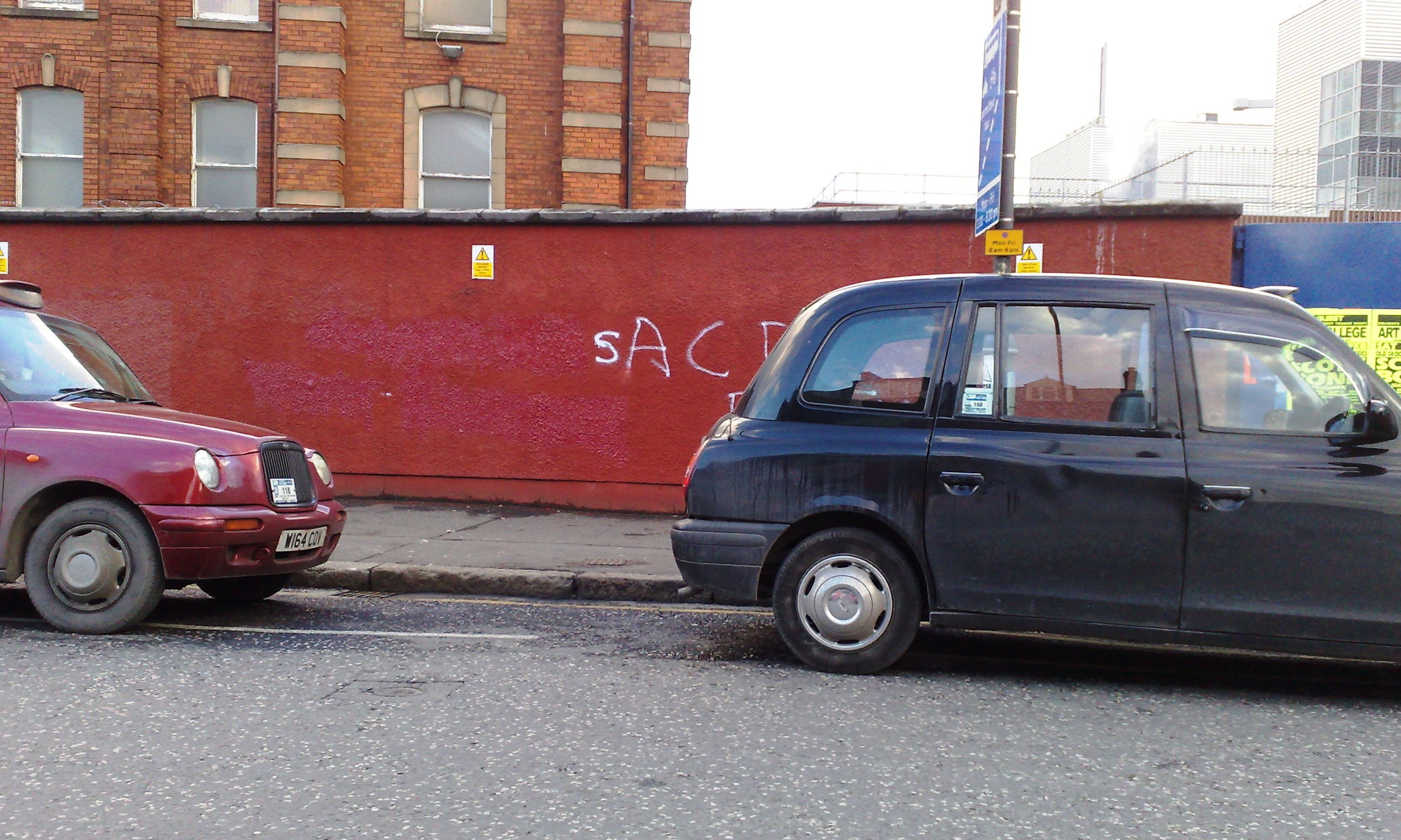
You have to be up early to catch graffiti that targets Gerry Adams, but it was still on the wall at the corner of the Grosvenor Road and Falls Road one morning at 8.30.

And here is the paint-out job, that afternoon (Feb 2 2010):

Crisis Fatigue

A sampling of voices on a Belfast city street suggests that people have very little interest in the political regime that serves them – crisis fatigue, perhaps.

Reading at The Wild Geese

I read a couple of pieces from Under His Roof, my book about my father, at The Wild Geese Literary Festival in Strangford on Feb 6.
It seemed to go down well.
You can hear a recording here:

Oh Mo!

Mo Mowlam surprised us all before she shocked us.
She was a heartening break from the sequence of plummy male
Secretaries of State whose job had been to speak implausibly for the
people of ‘Nawthen Arlan’ and their desire for peace. It is a pattern
we have now returned to, despite the sense then that she had broken
the mould.
She seemed an ordinary decent Northern woman, more like most of us
than the others were like any of us.
On her first day in office she got out of her car and walked about
meeting people in Donegall Place. Of course it was all PR, but it had
a grounded civility that none of her predecessors had quite managed.
And we knew while she was in office that she was a difficult woman.
There were early stories about her brain tumour, her weight gain, her
bawdy humour and how she stunned local politicians by taking her wig
off during meetings. All of these things made her likeable too. Though
not to everybody.
There is a scene in the film Mo, in which Julie Walters as the new
Secretary of State, confronting David Trimble for the first time,
spreads out her legs and tells the unionist leader that she is hiding
nothing from him.
Adrian Dunbar is as frighteningly good a Trimble as Walters is a Mo.
He plays a wooden and emotionally constipated protestant with nowhere
to look.
Yesterday Daphne Trimble traced that incident back to a meeting in the
Portadown constituency office, at which Mo met David Trimble and
Gordon Lucy. She says the meeting was not confrontational and that is
is nonsense to suiggest that it was then that David Trimble decided he
could not work with Mo. ‘Did he even notice?’ she said with a laugh.
In the film, the Mo that Trimble will have to deal with is shocking
and revolting. Her language is unquotable.
And that is how she was, apparently.
I remember once getting into a conversation with an ashen faced
broadcast technician who had just been dealing with her and he
expressed himself shocked and embarrassed. He did not expect to be
spoken to like that when he was doing his job, and he knew that a
colleague who addressed him in those terms would be asked to leave the
building. Apparently our local broadcasters have footage of the
moments before formal interviews, when sound levels and pictures are
checked, when she addressed them in the language of a docker.
Julie Walters’ portrayal of Mo is true to that experience.
Former members of her own staff complained about this behaviour. Andy
Wood, a press officer, later described how she had sent him out to the
shops for her tampons.
But there was warmth in her through all this. Local artists who have
been her guests at Hillsborough Castle have spoken of how she invited
them to use the Queen’s toilet, or even how she continued
conversations with them while having a pee herself.
Another civil servant I spoke to, on the day she left Northern
Ireland, talked of his first ‘ministerial hug’.
Two questions are implied by the film about this ribald and candid extravagance.
One is whether it worked some kind of magic among the stiff and
intractable local politicians. The other is whether it was really her
at all or a symptom of the tumour’s disinhibiting effect.
The producers of the film appear to believe that Mo came among us as a
saving angel, bringing joy and candour to a region that was humourless
and inflexible.
The weakness in the case the film makes is that that portrayal of
Northern Ireland does not ring true.
Mo’s first experiment in breaking down the reserve of a stuffy,
immovable poltiician is with Trimble. It fails. Trimble, in the film,
is so appalled by her that he simply refuses to deal with her, from
the first day. This is all good comedy and the target of it is the man
who became our first First Minister.
But is it true?
Well, Trimble can be stiff and irascible, but he too can also be funny.
And the fact is that he did work with Mo through the negotiations to
the Good Friday Agreement and that it was only later, during the
deadlock over decommissioning that he and his party worked more
directly to Blair and angled for Mandelson’s appointment.
The several interventions by Blair were presented as undermining Mo,
but this will seem particularly implausible in the week in which
Gordon Brown has similarly come in over the head of Shaun Woodward to
lead negotiations at Hillsborough.
Throughout the peace process, the heavy lifting has been done from
Downing Street and the job of Secretaries of State has been to
schmooze with the locals and placate them in small things.
The depiction of Adams and McGuinness is particularly naff.
They meet after a flirty call with Bill Clinton to have a wee word
with them to secure a ceasefire.
Actually the ceasefire was negotiated by the British and secured with
clear concessions to IRA demands. No one was quite as pliable as the
film suggests.
In their first meeting with Mo, they are like stuffed dolls.
Their first argument is about the question of whether the talks should
be time limited. Mo says they must be. A surly Adams says that a
problem that lasted eight hundred years can not be resolved in a few
months. A nice caricature, but actually the argument was the other way
round.
It was the republican movement which insisted on a time frame for
talks and refused to restore the ceasefire until that concession was
granted.
The murders of two policemen in pursuit of that demand should not have
been lightly omitted.
There are a lot of historical weaknesses.
We see Mo at Hillsborough Castle, on the day after the 1997 Drumcree
Parade making a snap decision to create a Parades Commission.
This is nonsense. There was a long preparatory period in which Rev
John Dunlop and Oliver Crilly drew up a report recommending the
commission. Unfortunately, it would feed nicely into Orange disdain
for the Commission to suggest that it was thrown together in a hissy
fit by a mentally unstable Mo.
And there are other historical weaknesses.
The SDLP does not even exist in the film. Couldn’t the producers have
had fun with Mo and a late night whiskey with John Hume of Seamus
Mallon?
There is practically no violence, other than in a collage of old
footage that she appears to witness through her car window as she
drives through the Bogside and Sandy Row from the airport to Donegall
Place.
The story of her visit to the Maze to meet Loyalist prisoners should
not have been told without an account of the killing by Loyalists in
Belfast in the same week.
And the producers presumably thought that mentioning the Omagh bomb
would have cast a shadow on the miracle ofpeace making they were
crediting her with.
But Mo has worked her magic and then been brought down, apparently
through a conspiracy between David Trimble and Peter Mandelson,
neither of whom could see what a world’s wonder she was. From there we
have the second part of the story that raises the question of how much
of her charm and influence came from the warping of her real
personality by the tumour.
Mo is persuaded by her husband that Blair is really jealous of her and
urges her to challenge him for the party leadership.
He is motivated by a sense that her political committment is
prolonging her life and that a reduction in her responsibilities will
bring her to an early death. What he sees, really, is that Mo needed
Northern Ireland more than Northern Ireland needed Mo.
It takes a word from the well grounded Scot, Adam Ingram, played by
Gary Lewis to put her right, but she never forgives him for that.
The deterioration of Mo is heart wrenching, and in the end she faces
the cruel question of whether she was ever really herself, when she is
told that she may have had the tumour for decades.
So even the fun-loving Mo that everyone had known before the illness
and the work in Ireland – never Northern ireland, in the film, for the
English don’t seem to know the difference – was a pathology.
This is a more serious question than the political one of whether she
really answered the irish question with a dirty joke.
It is a question about nature and the self, faced at the point of
death by a woman who finally doesn’t know who she was.
Julie Walters’ achievement in recreating this woman is a marvel. From
now on we will have a much firmer image in mind of the Walters’ Mo
than the real one, if there ever was a real one.

A Shame and a Disgrace

This piece was carried on the front page of the Belfast Telegraph on January 28, the day after Gordon Brown and Brian Cowen gave up mediating between Sinn Fein and the DUP on how and when to devolve policing and justice powers to the Northern Ireland Assembly. (See also.)

The British prime minister, Gordon Brown was back at work in London
last night, with his mind focussed again on crucial global affairs.
British soldiers are still dying in Afghanistan, the civilian death
toll there is in the tens of thousands and the shaky president of that
country, Mohammed Karzai, is in London today for a conference with
sixty foreign mnisters.
It wouldn’t be surprising if, in the midst of such a gathering, Gordon
Brown wasn’t to ask himself just how important his fruitless daliiance
in Hillsborough had really been.
The Taoiseach Brian Cowen was similarly getting back into his stride
in dealing with a crime wave whose death toll is nearly as bad as the
troubles were here and an economy in crisis.

It is an embarrassment for the people of Northern Ireland and a shame
on our political leaders that two such busy heads of government were
drawn here to try to resolve a political deadlock.
Compared to the other great crises which Gordon Brown has to manage
this week, Northern Ireland should be much smaller beer.

It is hard to be sure whether it would have been even more
embarrassing if they had succeeded, for that would have confirmed,
symbolically and in the eyes of the world, that we are in our
political infancy. As it is, our disgrace is that our intercommunal
intransigence has survived a 20 year peace process and looks as if it
might to define us in perpetuity.
Perhaps the British Prime Minister, Gordon Brown and Taoiseach, Brian
Cowen have learnt a lesson from the experience and will not indulge us
as lavishly again.
More likely the idea has become ingrained in British and Irish
political culture that pandering to our petulant divisions is one of
the first responsibilities of governments.
We are very tempted this morning to urge them to place Northern
Ireland, in a more realistic ordering of their concerns, much closer
to the bottom.
The experiences of their predecessors should tell them that the type
of high wire summitry which they engaged in this week often goes awry.
Remember the repeated efforts to resolve the decommissioning deadlock,
the Hillsborough talks session which has gone down in history as ‘the
April Fools’ Day talks’, or the ‘ seismic shift’ talks at which the
earth did not move. The governments have over and over again trusted
that the moral pressure which prime ministers can apply, by
withdrawing themselves from urgent work elsewhere, would be sufficient
to dislodge local political party leaders from fixed positions and
they have been wrong. They have several times spun their efforts as
far more creative and productive than they have turned out to be.
If the parties here are going to continue pleading with the Prime
Minister and the Taoiseach, and even with the president of the United
States, to do their jobs for them, then perhaps it behoves civil
society here to speak over the heads of political leaders about the
embarrassment of our helplessness.
Ordinary countries can not summon outsiders to solve their problems,
unless they are torn apart by calamitous warfare or a natural
disaster.
And the irony is that among the concerns which Gordon Brown had also
to address this week, and from which we deflected his attention, were
Haiti and Afghanistan.
Of course, Northern Ireland is not an autonomous polity and the agreed
devolution of powers is not complete. Britain and Ireland do have
responsibilities here. But we are supposed to have been long passed
the point at which we could reasonably confess ourselves helpless to
solve our problems.
Brian Cowen leads a country which is suffering appalling economic
setbacks and the threat of industrial action. He would have been
perfectly entitled to say that he could not come to Hillsborough
because he had other things on his mind. To think that he was summoned
here by Martin McGuinness, an officer in a political party which has
virtually no traction left in his jurisdiction!

The tradition of Taoiseachs and prime ministers dropping everything
and rushing to Belfast to save the assembly from yet another imminent
breakdown grew out of the fear that political deadlock would reverse
the peace process into a resumption of the Troubles. Tony Blair and
Bertie Ahern, in their day, believed they were saving lives when they
came over and called Republicans and Unionists to the talks table, and
they may well have been right.
We must hope that Brian Cowen and Gordon Brown at least trust now that
most of us want our politics to function without blackmail and the
threat of violence and would rather see the Assembly fall than be
sustained by fear.
The principle that they must respond with such urgency to fears of
institutional collapse and an assembly election, is grounded on the
assumption that we are basketcase political entity, and that in itself
is demeaning to the many people here, both in politics and in civic
society, who order their priorities pragmatically and in the interests
of the whole community.
And there has to be a realistic fear that if political party leaders
here feel that the Prime Minister and the Taoiseach are at their beck
and call, then they will be routinely tempted to turn disputes into
crises and party positions into threats of disaster.
There is an awful sense abroad that the political careers of some who
are prominent in the executive here were nurtured in the global gaze
and that these people still need the attention of the whole world
before they can function. There was a hint of that last week when
Martin McGuinness was asked for a comment on the allegations made
against Gerry Adams, that he had mismanaged complaints made to him
about the sexual predations of members of his party. McGuinness’s
answer was shocking in its naivete. He said it appalled him that the
media locally were attacking a man who had created one of the best
peace processes in the world.
We have to learn to live with the fact that we are not very important.
We are a region of one and a half million people.
We have been indulging an unwarranted self-aggrandisement. Academics
study us and international journalists write about us and wherever we
go on our own travels we encounter the sense among others that we are
one of the crucial conflict zones on the planet. Yet our conflict
barely rates against an ordinary gangland dispute in an American city.
Yet the peace process which delivered us into perpetual tetchiness is
held up as a model to the world.
We have to ask ourselves now if the political arrangements which we
have established are fit for purpose.
One of the problems is that we cannot legislate for amity or even
civility between parties locked into coalition. Jim Allister makes the
case that mandatory coalition is an unviable and unjust political
arrangement. But the dream that people in Northern Ireland had when
they voted for it, by a great majority, was not that it would be
‘conflict by other means’ or, as foretold by Peter Robinson, ‘a battle
a day’. They wanted it to be a co-operative partnership between
parties with a past history of animosity, and they wanted to see the
old bad feeling and suspicion put aside. They hoped that parties which
had inherited an oppositional mindset from decades of protest, might
learn to co-operate to the practical advantage of their people. They
hoped that when the DUP and Sinn Fein took responsibility for the
everyday governance of the whole region, they would be too busy to
rehearse old hatreds.
It has to be acknowledged that there are some in the Executive who
have confirmed our hopes and expectations. One cannot point the finger
at Michelle Gildernew or Arlene Foster or a few others and indict them
of mischief and dissension.
But Sinn Fein played the education portfolio as an irritant.
Similarly, the DUP has conducted the culture portfolio as if it was
the front line in an historic grievance.
Martin McGuinness clearly loves the position he holds and perhaps has
less of an appetite for stand-off than his party leader. On the other
side, the most irascible and smug provocations from the DUP have not
come from Peter Robinson. But both Robinson and McGuinness have played
bad hands in the long wrangle over when policing and justice powers
would be devolved to Northern Ireland.
Mr Robinson procrastinated until the European election arrived,
apparently fearing that his party candidate Diane Dodds would be
seriously wounded if he had conceded a date. Then, when she was
wounded anyway, he appears to have drawn the dispute out even further
and more slowly, making little concession to the inevitability that
there will always be another election to fear. And if he had at any
time conceded a date for policing and justice, he would have killed
the issue. Jim Allister’s only hope was that he could force Robinson
to delay it; he was never going to have a chance of reversing it.
There is no better argument against a staller than to show that the
deed is done.
Mr McGuinness lost two earlier opportunities to force his hand. One
was when Peter Robinson was installed as First Minister, and he might
have refused to put himself for nomination until a clear price was
paid. Later, after the money was agreed and the DUP linked the parades
issue to the devolution of policing and justice, he could have stormed
out with more credibility, if that was what he was inclined to do. The
old street warrior wasn’t as sharp as he might have been, and now the
ground has shifted under him. He missed opportunities to play it hard
and he waived the opportunity to play it soft.
He might reasonably have hoped that when, last March, he stood with
Peter Robinson and damned the dissident republicans as ‘traitors to
the island of Ireland’ that Robinson might have said then that the
confidence in Sinn Fein that he sought, was now clearly warranted.
Both parties drew out the dispute.The question many will ask, looking
back on that, is whether either or both of them did so on the
understanding that two governments would provide a safety net and
rush, in the end, to save them from themselves.
They would prove themselves better fit to govern Northern Ireland if
they would accept that they are stuck with each other, will still be
stuck with each other after an election, and got on with the jobs we
have entrusted to them.

The Robinson Affair

How long have we thirsted for a good scandal here? The enthusiasm with which the public is lapping up the Robinson Affair seems to reflect a deep and abiding need for colour and distraction on our political culture.
The whole settlement might be going down the tubes but hey, what a gas!
And that excitement which Iris has generated has made politics interesting for thousands who had just got bored.
OK, those thousands are maybe not focused on the damage this scandal is doing, the jeopardy that faces the institutions. but try and tell them now that they shouldn’t be mocking? You can’t.
Iris has changed the way we think about politics, and this has come as a relief for people for whom it had all become too worthy and tedious.
We have had fifteen years of solemnly intoning the mantras of the peace process, earnestly hoping that dealdines might be met and that deals might be completed and that peace would descend upon us.
More recently people have come to think that an actual healing of political and communal divisions in Northern Ireland is not possible. They went from being bored and earnest to being merely contemptuous of a political system which is inherently acrimonious and self indulgent.
And to think that our quibblers and ninnies in the assembly benches imagine that they are an example to the world of how peace can be made in other tumultuous conflict zones!
We have heard enough of that.
Hope and history don’t rhyme and never will.
But suddenly there is the Robinson Affair and all politics is human again.
We don’t have to reverently think of our representatives as historic figures who have excelled themselves in political courage and crerativity. Nor do we feel we must adhere to inflexible communal allegiances which require us to speak well of them. The people are laughing, and their mirth is as much from relief as from amusement. It is as if an onus of sobriety and conscientious commitment has been lifted from us.
The whole damn shebang might be about to slide into the ditch like last week’s snow, but what a story!
The people of Northern Ireland are responding to that story not with foreboding but with hilarity and amazement.
And this tells us that some of the big sacred notions of the peace process no longer hold us in thrall.
Remember them?
The greatest of these was The Big Picture.
Whenever we had doubts about the behaviour of paramilitary organisations or political parties engaged in negotiations, we were always reminded that we had to keep The Big Picture in mind. The Big Picture was the overall political settlement that would restore order and good government to Northern Ireland.
For example, when the IRA or the UDA killed somebody during the interparty negotiations, some politicians and journalists might have been tempted to fly off in umbrage at the audacity of these hypocrites, talking peace up in Stormont and killing or maiming people on the streets.
Invariably, when challenged on these barbarous acts, the political spokespeople of the killers would say something like this: ‘Yes, it’s terrible, these things happen; but keep your eye on The Big Picture.’
In the past we would have turned a blind eye to murder for the sake of political stability; today we won’t turn a blind eye to adultery and the shocking spectacle of a First Minister demanding that funny money be, not shuffled into a Swiss bank account but paid back!
The next big concept governing the peace process which has taken a dent is: History.
History, it was said, rhymed with Hope. It had a hand and Tony Blair felt it on his shoulder one night in Hillsborough Castle, while struggling not to succumb to soundbites.
An incredible number of incidents in recent years have been described as ‘historic’. Speeches by visiting poltiicians routinely opened with: ‘Ten years ago, who would have believed that ….’ They didn’t seem to notice that the more they said it, the more people did believe and the less amazed they were.
We had historic agreements, historic presidential visits, historic statements, historic acts of decommissioning and then more historic agreements. We even had historic attendances of ministers at football matches.
What went unnoticed was that people were gasping for the other thing we had been promised: Normality.
They didn’t want to see politicians doing grand things for the history books; they’d have settled for them getting the hospitals and the education system in order.
History, we were encouraged to believe, was not just ‘one damn thing after another’. It had purpose and direction. It was destiny, really. And it was taking us to a glorious future.
Except that it, in reality, History was just the past and there was no guarantee that marking one event or another as Historic would make its memory of influence endure.
Then there was Hope, the Hope that rhymed with History, according to Seamus Heaney.
But all we had had a right to Hope for was normality and we only had to look at neighbouring countries to see what normal politics was.
Normality included corruption and sleeze, governmental penny pinching, spin and deceit and back stabbing inside political parties. Normality in Westminster, for instance, is that every few months a minister resigns for not declaring interests, for cutting corners for migrant servants, for fiddling expenses or just to ‘spend more time with the family’. That’s normality; nothing to get excited about.
There were times when people here said things like: Isn’t it great that we are arguing over education and hospitals in stead of shooting each other on the streets?
Well, actually it would have been better if we had had our health and education services sorted out too.
Hope promised a shared future, reconciliation and an end to bickering and more bickering. But it didn’t deliver.
Occasionally, however, Hope offered the prospect that politicians who are thought to be making too much money and not doing enough work might be humiliated. That Hope appears, for once, to have been richly fulfilled.

Don’t Wilt, Iris

A humanistic view of marital infidelity would ask if both partners should take responsibility for one of them wandering. Lucky Peter Robinson; he gets his wife to take all the blame and then forgives her on national television.

Here’s a piece I publish in this morning’s Belfast Telegraph:

Part of the indignity for Iris Robinson is that her disclosures about
an affair contrast with an image which she has presented of herself as
a morally assertive and sexually prim woman.
There have been sexual infidelities in other political families in
Northern Ireland that have not brought people to the extremes of
attempted suicide and public confession.
The striking thing about the confessions we heard last night is that
no clear motive for them was made plain.
Peter Robinson said that part of the motivation was to end speculation
that his personal problems and recent absence from public life were
grounded in illegal financial dealings. And it is clear that he now
wants the media to stop investigating the affair that Iris had.

Spotlight on Spotlight

The Spotlight programme on BBC Northern Ireland has said that it is
still waiting for answers to a series of questions put to the
Robinsons. Presumably, a good result for Peter and Iris would be that
the planned Spotlight programme would be pulled. The Spotlight team
are now faced with the suggestion that humiliating Iris with further
disclosures would be bad for her mental health, and might cost her
life.
If there is any more to the First Couple’s desire to make this
heartrending public confession, other than to morally constrain
Spotlight, then it is perhaps indicative of a naivete about the rest
of the world’s expectations of them.
Iris, in particular, presents herself as almost legalistically religious.
At the time she was having her affair she was pontificating in the
media about the ‘abomination’ of homosexuality.
She brought heaps of grief upon herself over that whole argument.
She was ridiculed in much of the media and lampooned as a ridiculous
hate figure, most colourfully on the Gay Pride parade through Belfast.
Yesterday, on social networking sites, Iris was being traduced as a hypocrite.
It is hard to escape the sense that her own sexual frailties would not
have brought her such pain had she not succumbed to the fantasy that
she was pure and holy enough to dictate right and wrong to others.
You get a flavour of that smugness in the interviews she gave to
writer Lorraine Wylie three years ago for a book described as ‘An
Intimate Portrait’.
The book included accounts of life lived almost as a soap opera. One
memorable yarn recounts how the Robinsons got so sunburned on holiday
that they couldn’t put clothes on over their tender skin and set up an
arrangement whereby Iris would order room service from under the
bedclothes while Peter hid naked in the bathroom. The outworking of
that, as told in the book, was that Peter ‘glowing like a Sellafield
fish’ misheard his cue to come back into the bedroom and presented his
full glory to the waitress.
Iris also wrote of her fury at the vicious rumours about her marriage
and her husband. She said, ‘it never ceases to amaze me what
imagination can conjure up. I’ve heard my husband accused of
everything from infidelity to domestic abuse and even murder.’
The initial impact of the disclosures on last night’s news appears to
have been highly sympathetic.

God and Conscience

Journalists who were present when Peter Robinson made his statement
were clearly deeply moved by it.
Some will have been reading backwards to the extraordinary flashes of
temper from him in the past year and perhaps concluding that these are
more intelligible against the background of marital stress. And
religious people will note that both Iris and Peter emphasised the
power of God and conscience in their lives. It was guilt which drove
Iris to an attempt at suicide; it is the conviction that God himself
has forgiven her which consoles Peter.

And it is not only sexual indiscretion which Iris has owned up to.

The statement says that she provided financial support for her lover and encouraged others to as well.

But if they talk sometimes as if they are not quite human themselves,
they certainly appear a lot more human to the rest of us now.
Sexual infidelity is human. The grief of a betrayed spouse is human.
And it is human to plead in extremis for mercy from an investigative
media which might drag out the pain, even if it does not unearth more
dirt.
For Iris, now, political life is at an end.
This is a tragedy for someone who was a gifted parliamentary performer.
Sometimes the focus of her interest appears to have been punitive and
moralistic. A reading of the questions that she has asked in
Westminster over recent years shows a primary concern with the
treatment of prisoners and particularly of sex offenders.
She enjoyed politics. There was something almost exultant in the wrath
which she turned on Health Minister Michael McGimpsey in the assembly
and others. Being married to Peter Robinson may have been a political
advantage to her but it may also have carried considerable benefits to
him too. She seemed to soften him a bit. She was one of the more
colourful and intriguing characters. Life will be much more
embarrassing at church and among her own circle now that it is clear
how human and ordinary she is, but there are people who will like her
the better for it.
The other question is whether her marriage to the First Minister will
survive. He himself says that is not guaranteed and it may be that  he
was suggesting that the decision is still more with her.
She described her depressive illness as ‘personality changing’.
If she stays with Peter and accepts his forgiveness and can be happy
there, well and good.
If she moves on, and casts off some of that prissy conviction that she
flaunted so lavishly before, then who knows what she might be?
A potential embarrassment to the party if she no longer feels bound by
loyalty to it?
A wiser better person if she will let herself be ordinary and
vulnerable without feeling the need to expunge your own life when the
ardent facade breaks?
Or will she go into some kind of shameful purda?
Well, now that wouldn’t be the Iris we know at all.

A Visitor

Until a few years ago I never saw squirrels in Belfast. Then they started to appear in small numbers in the Ormeau Park. Now they are proliferating and this one has become a regular visitor to our garden.