It’s not hard to imagine the jaws dropping onto desktops when the
letter arrived from Culture Minister Nelson McCausland asking museum
heads to pay a bit more attention to matters of vital concern to him
like the Ulster Scots heritage, the Orange Order and the origin of the
universe.
On reflection, museum managers might have considered a range of
options short of telling him to get stuffed.
Mr McCausland’s view is that a museum should reflect the culture and
beliefs of the community it serves. In seeking to refute this, the
museums might seek to actively explain the world to a community with
reference to the gaps in the understanding of even its leading
cultural funders.
In short, if Mr McCausland wants the university to offer discussion of
Intelligent Design theory, let them do it. There are a lot of people
among us who believe that religion can still hold out against
scientific discovery. They would have been on the side of the Pope
against Gallileo and they still think they can refute Darwin. They
want to retain the conviction within scientific institutions like
universities and museums that God created the world in seven days.
Well, let them try.
The first comfort for museum heads is that Intelligent Design theory
is already a concession to science. It is a relaxation of the demand
by religious creationists that the Book of Genesis be taken as a
sufficient account of the emergence of the universe, life and
consciousness.
The court cases in the United States, around the demand for the
teaching of Intelligent Design , were attempts by religious
fundamentalists to argue science with scientists, conceding in effect
that there was no point in trying to impress them with scripture.
Scientists and secularists saw this as a threat. It was in fact, the
movement of religious fundamentalists on to ground on which scientists
can defeat them, if they are confident of the strength of their case.
Why shouldn’t we have an exhibition on Intelligent Design
incorporating a discussion of the arguments around it in the museum?
People like Nelson McCausland might soon discover that there is no
comfort in it for them. If they are hopeful that Intelligent Design
restores the Christian explanation of the Universe to them, then they
may be well served by having the full case and its implications laid
out for them.
The problem for creationists is that their argument, if won, might
only establish that an intelligence initiated the Big Bang.
For all they know, that intelligent being might have been killed in the blast.
He, she or it may reside still in another universe and have lost all
interest in this one. There are no grounds for supposing that that
being knows about us or has any benign intentions towards us. There
are no grounds even for supposing that it is an infinite Deity. There
may be another universe in which children spark off Big Bangs with
their chemistry sets. They may not even know that they are doing it.
They will live in a different time frame so our whole span of
existence in this universe may be just a blink to them.
The problem for Intelligent Design freaks is that they don’t read
enough science fiction.
Rationalists might say this is absurd. But we are already making black
holes under Geneva ourselves with the CERN project, so what is so
implausible about an intelligence more advanced than our own
conducting similar or more radical experiments elsewhere?
What Intelligent Design believers do read – some of them – is the
theories of John Polkinghorne, a scientist and minister of the Church
of England who won the £1m Templeton Prize for research that
reconciles science and religion.
The usual experience of religion in the contest with science is that
literal interpretation of scripture loses every encounter. Then those
who continue to insist that religion retains lost ground begin to
sound more desperate and absurd in the secular world. Scientists feel
little need to go on arguing points that they feel that they have won,
like natural selection. Some scientists like Richard Dawkins continue
to wave the victory in the faces of the religious defeated, but there
is no scientific need for them to do so.
Polkinghorne said that the universe looks like a ‘put up job’. If the
pull of gravity was fractionally greater than it is, the universe
would compact into a hard ball; if less, it would scatter like vapour.
It has to be just right if you are to have solar systems and planets.
Look at the Earth. Without a wobble in its revolutions there would be
no seasons and without seasons no cycle of nature. Without our
unstable crust there would have been no volcanoes and we would be a
ball of ice, but the instability has to be just enough to allow life,
not enough to destroy it.
So, what is the scientific answer to the perfect ‘just-rightness’ of
this universe for life? One answer, seriously put forward, is that
there are millions of failed universes, or universes that turned out
differently, and that this is the one that by chance is just suited to
us. That explains our survival agains the odds.
In other words, the answer is a call to faith in the existence of the
unknowable; the sort of thing that religious people come up with.
The difficulty in this debate is that both the religious and the
scientific contenders have cranks on their side; adamant Christians
who think the Bible tells them everything they need to know and ardent
rationalists who fantasise that the job of explaining the universe is
complete.
What about an exhibition at the Ulster Museum that acknowledges the
mystery of our being here as mortal but self conscious beings in an
unlikely universe?
Would Nelson be happy with that?
I suspect he would want to see models of humans hunting dinosaurs, but
it is easy to deny him myths for which there are no evidence.
But just because we have a crank for a culture minister doesn’t mean
that the unexplained universe shouldn’t enthrall us.
And some smarty pants in the museum is bound to agree that a serious
discussion of intelligent design theory would tick the right box to
get Nelson off his back.
Posted in Culture and Society, Politics, Northern Ireland, Religion | 3 Comments »
If you are missing Belfast you might like to take a walk around it with me on my new slideshow, History Behind Bars, currently showing at The Street.
Posted in Belfast, Culture and Society | 3 Comments »
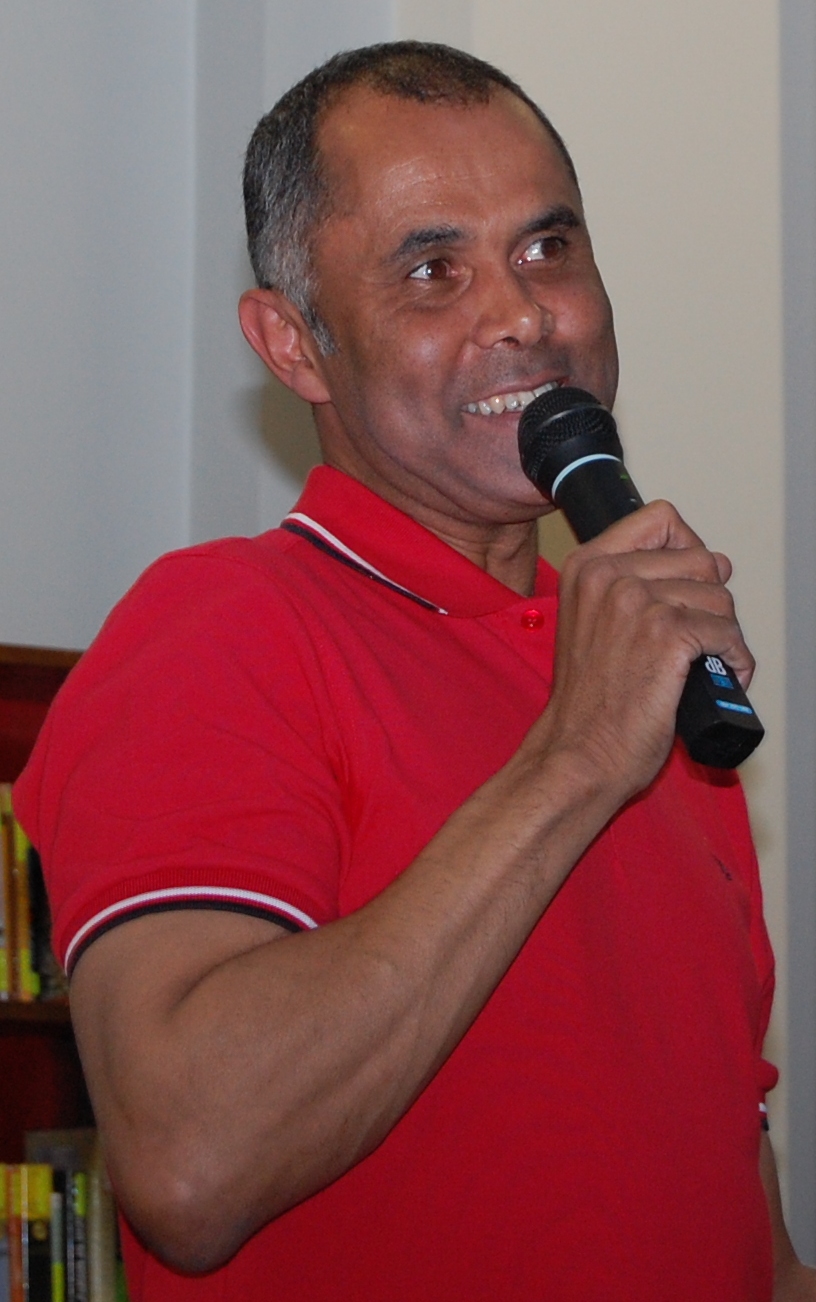
Tim Brannigan’s new book, Where Are You Really From? recounts the life of a black boy born in Belfast who became a Republican activist.
Is having two identities a freedom or a burden? That’s a question I explored with him and others in similar double identity situations.
http://malachi.podcastpeople.com/redirect/media/38421malachi-o-doherty-38421mp3Posted in Belfast, Culture and Society, Politics, Northern Ireland | Leave a Comment »
I have often sat out in the garden in sunshine and marvelled at how accustomed I had become to what you’d expect would be a major disruption; having to break off conversation, for instance, as another roar descends.
Now that the planes have stopped the peace is creepy.
Others – many of my Facebook friends among them- are remarking on how pleasant it is to have this silence. Well, yes. I go on holiday for silence like this. I pay good money for it, but I live in a city and I expect a city to sound like a city. And if it doesn’t, then something in me reacts instinctively, a bit like the cowboy in a hundred films who notices that the war drums have stopped; far more ominous than the drums themselves.
There is no point pretending that our world hasn’t changed. OK, the threat of volcanic ash drifting down from Iceland is obviously one we should have anticipated. What else has Iceland got, apart from volcanoes?
But a perfectly inevitable disruption has arrived and reminded us how complacent we have been. The change is that we can not be so complacent again.
I have been planning to fly to Barcelona at the weekend. The weather forecast says I might be able to get away. Can it assure me that I will get back; that the winds over Ireland or Spain or the skies in between won’t have closed the route again while I’m gone?
For now we anxiously await the reopening of our airports, but how stable will air traffic seem even when flights are cleared for take-off?
On this little archipelago off the west coast of Europe we have been obsessed with the winds. If we didn’t have weather forecasts with every news programme telling us what way the winds are blowing and whether they are carrying rain, snow or clearing the way for ridges of High Pressure (Yo!) we would feel isolated and deprived. Now we need Angie and Celia to keep us informed about ash flow.
It is intrinsic to our lives as islanders that we take the first buffetings from arctic storms and that we also receive balmy southern breezes that bring whiffs of the Azores to us. Our collective mood draws on the weather, as the weather draws on the wind. Now we are reminded of our dependency on the wind and our freedom to travel abroad seems once again as reliant on its force and direction as in the days of sailing ships.
We can not feel secure any more in booking flights abroad and must always consider the danger that we will be stranded; certainly as long as this volcano blows, but in the long term too, considering that there will be other volcanoes.
The question we are confronted with is whether our modern technologically based life style can be maintained on a fickle and unstable planet.
We had been anticipating that the great reverses of our growth and development might come from climate change or awesome calamity, an asteroid strike or a super Volcano like Toba in Sumatra, which deforested India and started an ice age. And we have no assurance that something like it won’t happen again.
But we enjoy the comfortable delusion that we don’t really suffer natural disasters in Ireland. The tectonic plates grind each other only thousands of miles from us.
We have the evidence all around us of volcanic seizures reshaping the landscape, but we all know that’s not going to happen again, don’t we?
Who’s afraid of Slemish or Knocklayde?
But now we do know that a fundamental or our lifestyle, air travel, can be stopped by a minor volcano, far away, and we are suddenly much more vulnerable than we ever imagined.
For the moment we must plan our practical adaptations. The wind may scatter the ash back north and release us, but air travel has suffered already. The fall out will be financial. Travel must now become more expensive to cover the losses. Some companies will fold.
And the public will remember which companies looked after them and kept them informed and which didn’t.
I find that I can not cancel my flight to Barcelona; but can only transfer the payment to another flight some other time. That’s Easyjet and online booking for you. The stranded and those who have had to change their plans will want to be sure in future that they are dealing with people not computers, and a company that can adapt immediately to problems like these.
Coming after a winter of delays and on top of the ludicrious policing of the liquids in our hand luggage, people must be starting to wonder if travel by air is, after all, worth it at any price.
It may be as expensive to holiday in Ireland but at least you have a better chance of getting home afterwards.
In the long term we have to adapt philosophically and incorporate our new understanding of our vulnerability into our world view.
Humanity has spread over the earth like an infestation, with incredible rapidity, and that recent growth has relied on technology of a kind that can be disrupted by minor and routine natural events; indeed, if we think in terms of Nature’s routines, we have to include climatic and seismic disruptions that we could not survive.
We can not defeat Nature, so perhaps we just have to be more stoical, like our grandparents were. Some days you just have to accept that you are going nowhere.
Posted in Uncategorized | Leave a Comment »
A few private thoughts will have circulated among churchmen and their
critics when the news came through on Tuesday night that Cardinal Sean
Brady had been rushed to hospital.
Those who love and defend the Cardinal, as many do, will have worried
that this was the outworking of the pressure put on him by media
manipulators and scandal mongers who have never understood the
Catholic church or known what a good man he is.
Others will have thought, more deviously; Isn’t this convenient?
At 70 the Cardinal does not look like a spry and durable man but he
climbed the pilgrim mountain Croagh Patrick just a few years ago and
he may have a more robust body under that black suit than is suggested
by his ambling manner.
He is not due to retire until he is 75 but an early retirement on
health grounds might be the best diplomatic response to the pressure
on him to resign.
In 1975 Fr Sean Brady, as he then was, administered an oath of secrecy
to young people who had been abused by the horrific Brendan Smyth.
Smyth was one of the most prolific predators on children to have
emerged from a church that has, we now know, never been short of the
type.
Cardinal Brady told his congregation on St Patrick’s Day that he would
take the season of Lent to reflect upon his position. That now extends
to Pentecost. Other bishops similarly tainted by their association
with inadequate episcopal procedures for curtailing paedophiles –
usually by shifting them to other parishes – had offered to stand
down.
Brady was heartened that his congregation applauded him and he said
that we wanted to consider whether the church still had a place for a
wounded healer, comparing himself to St Patrick.
If this seemed not the right tone for a man who was conceding that he
had done wrong, few in the pews seem to have been offended.
One of the concerns of many Catholics in Armagh is that Sean Brady is
being reviled for doing what any other priest of his standing at the
times would have done, he followed the instructions of his bishop, to
whom he had sworn obedience.
Another concern is the old rivalry btween Dublin and Armagh over who
leads the Irish church. Armagh is proud to be the seat of the Primate
and to have a primate who is a cardinal. Some would worry that the
centre of gravity of the irish church would shift south and that the
historic ecclesiastical capital would lose it shine.
And in Dublin there is an archbishop who now makes a more credible
case for himself as a champion of the new clean up in the church.
Of course, the church is making such a botch of presenting itself as
more concerned to protect children than to preserve its good name,
that it can not be safely assumed that men like Archbishop Diarmuid
Martin will prevail anyway.
After the publication of the Murphy Report, disclosing the scale of
abuse in the archdiocese of Dublin last year, the church had seemed
ready to accept radical change.
Since then it has made a series of horrific mistakes.
The pastoral letter to the people of Ireland from the Pope himself
plainly dismissed the claim that the application of canon Law had been
part of the problem. It said that Canon Law had simply not been
properly applied.
So it was still, in his eyes, the job of the church to punish
paedophile priests, though the state should be deferred to in its
‘areas of competence’.
The latest smug riposte was the drivel from Cardinal Bertoni in
Brazil, suggesting that child abuse was more likely to stem from
homosexuality than celibacy.
Other senior churchmen have maintained the line that the church is
under attack from the media.
One said last week that he had heard the persecution of the church
compared to the persecution of the Jews.
The men who would be the moral leaders of the whole world may preach
the parable of the mote and beam but many appear not to have grasped
its meaning.
And this deepening defensiveness within the church comes in the run up
to a papal visit to the UK.
And anger is growing there, so much that it seems unlikely that the
Papal visit can proceed without protest.
Gays will not accept that they are more likely to rape children than
are men who commit themselves to living celibately for God.
And the legal case that the Pope is himself answerable for the cover
up of abuse all over the world now seems strong enough to warrant
testing if there was a court he could be brought before.
In all of this, there must be many in the church who realise that the
only way to prove good intention and a proper sense of moral
responsibility is to sacrifice a sacred cow.
And there he goes, striding the holy hills of Armagh, fit as a sandboy
but succumbing to pressure.
They may hope there are medical grounds for prompting him to make a
dignified stand down. On the other hand, they may be starting to
realise that sacking him out right would be the better face saver.
More likely they will do nothing, for this is a church as frail as the
dim old men who lead it, men unfit for clear action or moral courage,
hobbling through every crisis.
Posted in Religion | 1 Comment »
This was the view from our picnic over Cushendall bay yesterday afternoon, April 11. Anyone know what they were up to?

Posted in Uncategorized | 2 Comments »
Revelations last week that the Primate of Ireland, Sean Brady (a cardinal) had administered oaths of secrecy to children who had been sexually abused by Brendan Smyth (a priest) led to calls from many Catholics for his resignation.
Others were more supportive and thought a good man (Brady) was entitled to forgiveness for his mistake (failing to report the raping of children to the police).
The first podcast is based on interviews with Catholics in Belfast.
The second is based on interviews with prominent Irish poets from Catholic backgrounds.
Posted in Uncategorized | 1 Comment »
The Pope is patronising us.
The BBC reported his letter as an apology butit was nothing of the
kind, for he takes no responsibility at all for abuse or cover-up. He
is sorry in the way he might be sorry for the Haitian earthquake,
sorry it happened.
The most distinctive feature of his pastoral letter is his confidence
in his superior wisdom and in Rome’s detachment from the problem of
child abuse in Ireland.
His contribution to putting things right is to urge the church to pray,
and to rebuke bishops for having failed to understand canon law when
they protected abusers from the police.
He speaks of ‘information that has come to light’, as if it was news
to him that some priests had been raping children here for decades and
that his own bishops had been swearing traumatised children to
secrecy.
He refers repeatedly to the Irish bishops coming to him and reporting
the problem. He has listened to what they had to say, like a parent
who has summoned children to explain how a window had come to be
broken.
He has provided Irish Catholics with a prayer to say and he has urged
a special Mission to reflect on the sins of the past; he even promises
us an ‘Apostolic Visitation’. By this he means, I presume, that he’ll
be checking up on how well the local church is responding to his
advice and guidance.
Expect a lot of breast beating by bishops and clergy as they indulge
their remorse and come to feel better about themselves.
The letter addresses all the faithful of Ireland and sets out hopes
for the future, which are simply that the people will pray more
ardently and recover their respect for their clergy and their bishops
and that the tsunami of horror raised by the scandals will not reach
Rome.
The Pope’s entire approach is as a wise teacher who has had nothing to
do with the creation or perpetuation of the problem of child abuse by
priests in Ireland, or the cover up, and who can put it right if we
follow his advice; which is to pray.
And Cardinal Sean Brady, who got into trouble by being a company man
at the start is loyal still and has welcomed the letter, expressed his
gratitude for it, as if the Pope had gone to some great trouble for us
all by writing it.
I wonder who did write it.Clearly somebody with a knowledge of Irish
history and an expectation that Catholics today will mellow in the
face of appeals to remember the history of the Irish Catholic
martyrs, ‘the rock from which [they] were hewn’.
The letter reflects on the history of Catholic persecution and the
rapid expansion of the church in Ireland after Catholic emancipation.
The writer occasionally loses the run of himself: ‘In almost every
family in Ireland, there has been someone – a son or a daughter, an
aunt or an uncle – who has given his or her life to the Church.’ This
overstates the enveloping scale of Irish Catholicism to the extent of
failing to notice that there are Irish Protestants too.
The pitch is to Irish Catholics to feel good about themselves; to
remember their proud history and not to be disheartened by the
scandal; it is an appeal to them to indulge instead the old fantasies
about the land of saints and scholars.
Much of the letter reflects on the creation of the problem of abuse.
None of the blame attaches to Rome. There were poor selection
procedures for priests and bad training in the seminaries, a culture
of deference in our society and ‘a misplaced concern for the
reputation of the Church and the avoidance of scandal, resulting in
failure to apply existing canonical penalties and to safeguard the
dignity of every person.’
The Pope accuses the bishops of failures of leadership and a
misapplication of canon law and tells them to ‘continue’ co operating
with the civil authorities, as if there was never any impediment to
them reporting abusers to the police, other than in their own failure
to grasp Rome’s intentions.
In other words, when Sean Brady was imposing oaths of silence on abused
children, it was out of a misreading of canon law, not a judicious
application of it.
The cardinal may be grateful for these Papal insights, as he says, but the
Pope has just washed his hands of him.
The letter says, ‘In particular, there was a well-intentioned but
misguided tendency to avoid penal approaches to canonically irregular
situations.’
The tragedy is that abuse has ‘obscured the light of the Gospel to a
degree that not even centuries of persecution succeeded in doing’.
So the letter concedes nothing to those who blame the cover up on
systemic failures within the Catholic church. There is no suggestion
anywhere that Rome was part of the cover up or that those priests and
bishops who protected abusers from the law had any endorsement for
their measures from the Vatican.
The Pope believes the Catholic church in Ireland can be restored to
former glory and that the scandals of abuse and cover up can be put
behind us. This is good news for anyone who feared for a moment that
the church was going to change rules on celibacy or obedience or
seriously consider that there was anything systemically wrong with it.
The only problem, after all, was the bishops and their recruitment and training
procedures and a weakening of the faith.The Pope trusts that all that
can be put right and that things will be back to normal before long.
Posted in Uncategorized | 1 Comment »
 I saw this protest outside the church of St Nicolas in Nantes last week, March 13. The Catholics on the church steps were conducting a service around an icon, the protesters were objecting to Catholic teaching on abortion and women’s rights, and the police were in the middle.
You can hear both the protest chanting and the prayers in this clip below.
Posted in Culture and Society, Religion | Leave a Comment »
Welcome
This is the blog of my journalism and recordings, with some extracts from my books too. I tend to sound off on Northern Ireland Politics and Culture. Some of the work here will be recent journalism, articles that have appeared in the Belfast Telegraph or elsewhere, but there is a lot of material going back a couple of years now, so please hang around and browse. Malachi
Audio Highlights
The Street
-
Recent Posts
January 2026 M T W T F S S 1 2 3 4 5 6 7 8 9 10 11 12 13 14 15 16 17 18 19 20 21 22 23 24 25 26 27 28 29 30 31 Tags
accident arab army Bartlett Belfast Benghazi Bet bicycle bike bloodshed Christmas climate Collins commandos crime culture cycling death dog Donegal Don Juan DUP Economy Eoghan Euro father financial speculation gadaffi Greece Haass Harris IRA Ireland Israel Jude Letter Libya massacre memoir museum nature Northern Ireland O'Doherty OTRs peace Police Politics protest PSNI Religion religon Santa sectarianism Sinead Morrissey slaughter Terror terrorism weapons weather wind writers
 Malachi O'Doherty